
The first few minutes with Mouse P.I. For Hire were a perfect example of a game that can completely win you over with its atmosphere while simultaneously driving you crazy with its controls. On one hand, you’re looking at this black-and-white, old-school world filled with trench coat-wearing mice and thinking, Alright, this is exactly my kind of game. On the other, you’re wrestling with a camera that seems determined to drift off into space, while the sensitivity and movement sliders are labeled as if someone rushed them through an online translator—assuming they have any descriptions at all. Somewhere between fascination and frustration is where I ended up spending the next few hours in Mouseburg.
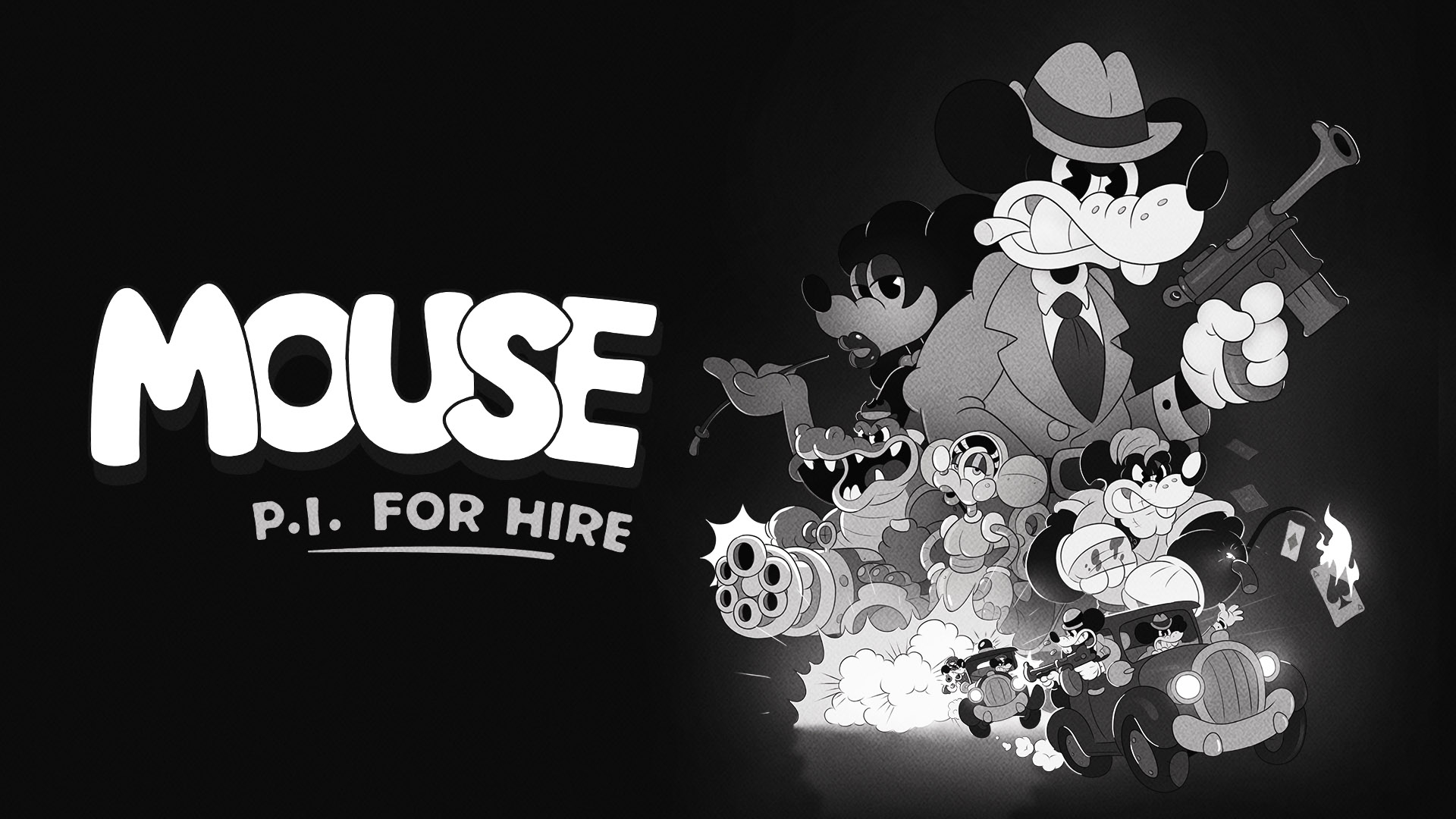
Let’s start with what Mouse P.I. For Hire is actually trying to be. It’s a first-person shooter set in the 1930s, in a world inhabited by anthropomorphic rodents—mostly mice, but also rats and shrews—living in the aftermath of a conflict known as the „Big Squeak.” Sounds ridiculous? A little. But from the very beginning, the game knows exactly what kind of atmosphere it’s aiming for.
You play as Jack Pepper, a private investigator and decorated war veteran whose seemingly straightforward case quickly spirals into a tangled story of corruption, kidnappings, and political conspiracies. Mouseburg itself is pure noir: smoke-filled streets, a detective’s office covered with photos and red strings, glamorous theaters, movie studios, filthy sewers, and murky swamps. Everything is hand-drawn frame by frame in the style of classic cartoons, giving the world a constant sense of movement. The result feels like a forbidden 1930s animated film somehow transformed into a modern first-person shooter.
And that’s where the game truly shines. The premise is simple: you solve one case after another, gradually uncovering pieces of a much larger conspiracy while exploring increasingly unusual parts of the city. Thankfully, the developers make sure it never turns into a slow-paced detective game overloaded with endless dialogue. Mouseburg is constantly alive. You can chat with its residents, gather clues, take on side cases, or simply soak in this wonderfully bizarre rodent society. The story takes you through a wide variety of locations—from dark alleyways and wealthy districts to movie sets and eerie swamplands—but despite the changing scenery, the game maintains a remarkably consistent tone. More importantly, when it touches on themes like corruption, violence, or tensions between different species, it does so through its characters and situations rather than heavy-handed moralizing.
From a gameplay perspective, Mouse P.I. For Hire is first and foremost a fast-paced shooter that hates seeing you stand still. Combat revolves around constant movement—strafing, dodging, short dashes, and jumps—with new traversal tools gradually expanding your options, including grappling points that launch you across arenas and a hook that lets you swing over enemies. The arsenal is equally satisfying. Alongside the expected pistols, rifles, and shotguns, you’ll unlock increasingly outrageous weapons and gadgets that fully embrace the game’s cartoon-inspired style. Explosions, splashes of ink, and exaggerated enemy reactions constantly fill the screen, making firefights feel like a violent 1930s cartoon brought to life. In practice, battles become a frantic dance across the arena as you weave between enemies, unload weapon after weapon, and let an energetic jazz soundtrack carry the momentum better than half the visual effects on screen.
The problems begin when all that speed and mobility meet the Nintendo Switch 2 Pro Controller. I suspect the same issues may apply to other controllers, but my entire playthrough was on Nintendo’s console. By default, your character feels as if they’ve had far too many espressos. Movement is incredibly fast, the camera even faster, and it’s remarkably easy to overshoot every little adjustment. You try to make a tiny correction with the right stick, and the game reacts as though you’ve slammed it all the way to the edge. There is a surprisingly deep settings menu with separate sliders for horizontal and vertical sensitivity, aiming, and movement, but the game does a poor job explaining what any of these options actually do or how they interact with one another. The result is fifteen minutes of tweaking sliders by one or two points, jumping back into the game, only to find the camera suddenly accelerating again or slowly drifting upward as if it were more interested in the sky than the enemies standing in front of you.
Combined with my already mixed feelings about the Switch 2 Pro Controller itself, the experience occasionally became genuinely exhausting. It’s rare for a game’s controls to wear me down this much, but after longer sessions I found myself feeling more tension in my hands than satisfaction from winning another firefight. The issue wasn’t the difficulty—it was the constant struggle with sensitivity, dead zones, and the overall feel of aiming. Yes, you can eventually adapt, and you can spend even more time experimenting with the settings until you find something that works. But for a large part of the game, I felt as though I was the one adapting to Mouse P.I. For Hire, instead of the game simply getting out of my way and letting me enjoy it.
Thankfully, the overall structure of the game does a lot to offset that frustration. Between the intense firefights, you’re given quieter moments to collect clues, examine your investigation board, search for secrets and hidden switches, or talk to various characters to uncover additional information. It’s not a particularly deep detective simulator or point-and-click adventure, but it’s refreshing to see the game slow things down every now and then instead of throwing you from one gunfight into the next. Those quieter sections make Mouseburg feel more like a living city rather than just a collection of combat arenas connected by cutscenes.
That said, not every interaction is clearly communicated. More than once, I found myself wandering around my office—or an entire level—looking for the one specific object that would trigger the next story beat. At those moments, I felt less like a clever private investigator solving a case and more like a walking cursor desperately searching for the one active pixel.
One of the more enjoyable side activities comes in the form of safe-cracking and hacking minigames. They’re nothing overly complicated—mostly short, rhythm-based challenges that rely on good timing and coordination—but they’re surprisingly satisfying. Once you lock into the rhythm, bypass another security system, and hear the satisfying click of a safe unlocking, it’s hard not to smile.
They also provide a welcome change of pace after the game’s more chaotic combat encounters, helping Jack Pepper feel like an actual detective instead of just another cartoon action hero mowing down enemies. Ironically, it’s the enemies themselves that expose one of the game’s biggest weaknesses. There are plenty of them, but not much variety. For most of the campaign, you’ll be fighting the same handful of mouse, rat, and other rodent archetypes armed with either melee or ranged weapons. Before long, the repetition becomes impossible to ignore.
Because the enemies are stylized 2D sprites placed inside fully 3D environments, identical character models and animations stand out almost immediately. The same silhouettes, the same running animations, the same reactions when they’re hit. Considering how distinctive and polished the game’s visual style is, it really could have benefited from a wider range of enemy designs—different outfits, body types, or movement patterns would have gone a long way.
That’s especially noticeable because Mouse P.I. For Hire isn’t a short game. A full playthrough can easily stretch beyond ten hours, and there are moments when it feels like some of that content has been padded out a little too much. It’s hard not to notice when you enter yet another large warehouse or arena only to face the exact same enemies, simply arranged in a slightly different formation.
From a narrative standpoint, Mouse P.I. For Hire delivers a genuinely solid experience. Jack Pepper is exactly the kind of protagonist you’d expect from a noir detective story—a tough private eye with a sharp tongue—but the game also gives him enough personality and emotional baggage to make him feel more than just a stereotype. His past regularly resurfaces through dialogue and cutscenes, while his constant internal monologue does a lot of the heavy lifting. As you explore the city, examine evidence, or question another suspicious character, Jack frequently chimes in with a cynical observation or a dry one-liner. It gives even the quieter moments plenty of personality, preventing them from feeling like little more than walking between objectives.
The supporting cast also deserves credit. You’ll meet street informants, corrupt police officers, shady businessmen, and wealthy clients whose tailored suits hide far dirtier ambitions. The story doesn’t reinvent the noir formula, but it’s written with enough confidence that I genuinely wanted to uncover the next piece of the conspiracy and see where each new investigation would lead.
The audio design is another highlight. Jack Pepper’s voice actor perfectly captures the noir atmosphere, effortlessly shifting between weary sarcasm and more emotional scenes. It never feels like someone simply reading lines from a script. The supporting performances are equally convincing, even if some characters lean into familiar archetypes. The real standout, however, is the soundtrack. Big-band jazz, lively brass sections, and energetic rhythms elevate every firefight, while quieter tracks fade gently into the background like cigarette smoke drifting through a detective’s office. Add in satisfyingly punchy sound effects—from booming gunshots to exaggerated cartoon explosions—and every encounter feels appropriately impactful.
Unfortunately, the Nintendo Switch 2 version can be a little inconsistent from a technical standpoint. The game targets 60 frames per second in Performance Mode, but it doesn’t always manage to maintain that frame rate, especially during larger combat encounters packed with enemies and visual effects. In a game built around constant movement and precise aiming, every noticeable drop in performance is immediately apparent.
There are also occasional stutters while new areas are loading and moments where animation pacing feels uneven. The game’s high-contrast black-and-white presentation only makes those hiccups more noticeable. None of this turns Mouse P.I. For Hire into a technical disaster, but it does chip away at the fluidity and responsiveness that are so fundamental to the overall experience.
So, what ultimately works—and what doesn’t? Without question, the game’s greatest strength is its atmosphere. A noir detective story starring anthropomorphic rodents sounds like an idea that could easily become a one-note gimmick, but Mouse P.I. For Hire fully commits to the concept, and it pays off. Jack Pepper is a compelling lead, the hand-drawn visuals are consistently striking, and the jazz soundtrack ties everything together beautifully while giving every gunfight an extra burst of energy. Most importantly, the game is simply fun to play. Charging into another location, surviving another frantic shootout, cracking another safe, and dismantling yet another criminal operation creates a satisfying gameplay loop that’s difficult to put down. It’s one of those games that constantly tempts you with the same thought: just one more mission, one more fight, one more safe to crack.
The problem is that the game’s weaknesses become just as noticeable as its strengths. After a dozen or so hours, the limited enemy variety and repetitive encounters begin to wear thin. Add to that the technical shortcomings of the Nintendo Switch 2 version, along with what frustrated me more than anything else—the overly twitchy controls and surprisingly unintuitive camera settings—and it’s clear this isn’t a flawless experience.
Ultimately, whether you enjoy Mouse P.I. For Hire will depend on how much you’re willing to overlook those issues. If you love fast-paced shooters that reward constant movement, and you’re drawn to the idea of noir filtered through the lens of classic cartoons, there’s a good chance you’ll have a great time. Just be prepared to wrestle with the control settings, tolerate occasional frame rate drops, and accept that the enemy roster starts feeling repetitive long before the credits roll. On the other hand, if you’re particularly sensitive to erratic camera movement, inconsistent responsiveness, or you’re simply looking for a slower, more story-driven experience, you may find yourself losing patience before Jack Pepper and his cynical wit have a chance to win you over.
So, is it worth playing? From my perspective, absolutely—but with an asterisk. Mouse P.I. For Hire succeeds first and foremost because of its atmosphere, its distinctive visual style, and its unusual blend of cartoon violence and classic noir storytelling. The shooting feels satisfying, the minigames provide welcome variety, and the story remains engaging enough to keep you invested until the very end. At the same time, I couldn’t shake the feeling that the controls and camera were constantly draining some of the fun out of the experience. I spent far too much time tweaking settings and trying to tame movement that often felt more twitchy than responsive.
Even so, I still rate Mouse P.I. For Hire highly. For me, it’s a strong 8 out of 10, with the caveat that it could have been even better had the developers polished the controls and improved the technical performance of the Nintendo Switch 2 version.
On a more personal note, Mouse P.I. For Hire definitely managed to frustrate me at times. But it only took a few minutes of satisfying combat, another fantastic jazz track, or a beautifully designed corner of Mouseburg to pull me right back in. It’s one of those games that leaves you remembering far more than its technical flaws. What stays with you are the memorable moments, the unmistakable atmosphere, and the satisfying click of another safe swinging open. If you’re willing to accept its quirks, you’ll find a remarkably stylish and genuinely entertaining shooter underneath them.