

I’ve been a huge fan of the Onimusha series for a long time. My journey with it began back on the PlayStation 2, specifically with Onimusha 3: Demon Siege, and honestly, I couldn’t have picked a better place to start. Even back then, I loved the way the series blended several different ideas. On one hand, it had an atmosphere that could, in some ways, bring Resident Evil to mind – puzzles, key hunting, exploration, and that distinctive style of gameplay so typical of games from that era. On the other hand, though, Onimusha felt lighter and much more focused on action. And, above all else, there was feudal Japan. That setting alone made a huge impression on me. Add impressive graphics for the time, satisfying sword combat, and demons that only added to the atmosphere, and you had an adventure that really stood out. But Onimusha 3 had one more ace up its sleeve – Jean Reno. The French actor played Jacques Blanc, a police officer who, through a series of events, finds himself transported to feudal Japan. At the same time, Samanosuke Akechi, the protagonist of the earlier games, ends up in modern-day Paris. As a young player, I thought it was something genuinely special. Samurai, demons, time travel, and contemporary France might sound a little absurd on paper, but somehow, it worked surprisingly well. Of course, I later played other entries in the series, but the third game has always remained particularly important to me. That is why, over the following years, I watched with a certain sense of disappointment as Onimusha slowly disappeared from the gaming landscape.
We had to wait a very long time for a proper return. Fortunately, in recent years, Capcom has clearly remembered just how many interesting franchises it has in its catalogue. The company has started revisiting its classic IPs, either reviving or refreshing them, and Onimusha fans finally received a brand-new entry in the series. And that brings us to Onimusha: Way of the Sword. Before we go any further, I would also like to thank Cenega for providing me with a review code for the game.
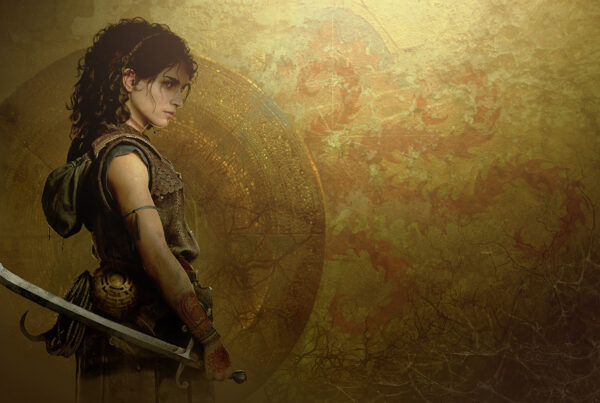
The new Onimusha does not directly continue Samanosuke’s story. This time, we step into the shoes of Miyamoto Musashi, a character inspired by the real-life legendary Japanese swordsman. However, he is not the kind of hero who wants to save the world and everyone around him from the very beginning. Quite the opposite. Musashi is quickly attacked by the Genma, dies, ends up in hell, and then, somewhat against his will, receives the magical Oni Gauntlet – a glove that allows him to return to the world of the living. Of course, nothing is ever that simple. The gauntlet allows Musashi to fight the Genma and absorb the souls of defeated enemies, but at the same time, it is something the protagonist would very much like to get rid of. However, if he wants to reclaim his old life and free himself from this entire mess, he has to do exactly what he never wanted to do in the first place – fight more demons and complete the tasks that will eventually bring him closer to getting rid of the cursed gauntlet.
The story of Onimusha: Way of the Sword is, in my opinion, simply okay. It is not bad, it does not get in the way of the gameplay, but I also do not think you will spend much time thinking about its plot once you put the controller down. Do not expect a complex drama with countless storylines, huge plot twists, or a story that will stay with you for years. It is a fairly straightforward tale, and its main purpose is to take us from one encounter to the next. There are demons, new threats, and massive bosses, while the story gradually reveals what is actually happening in the world around us. There are also plenty of different Genma, ranging from basic enemies and stronger units to opponents attacking from a distance. Overall, their design is quite successful and fits nicely into the atmosphere of feudal Japan overrun by demons, which remains one of the greatest strengths of the entire series.
Musashi himself also plays an important role here, as he is a genuinely enjoyable protagonist. He is confident, occasionally ironic, and, most importantly, he is not another hero who wants to save the world and everyone around him from the very beginning. He simply finds himself in a situation he somehow has to escape from, so he reluctantly accepts the various tasks, fights against the Genma, and deals with all the supernatural chaos surrounding him. More than anything, he wants to get rid of the gauntlet and regain control over his own life. It may not be the most original story, but for an Onimusha game, it works well enough.
My biggest problem begins when we get to the actual gameplay. On the one hand, Onimusha: Way of the Sword delivers genuinely satisfying sword combat. Cutting through enemies, dodging, blocking, and reacting to their attacks all work well and can be a lot of fun. The problem, however, is that it is hard to shake the feeling that, in 2026, we have seen all of this many times before. The combat system can occasionally bring soulslike games to mind. We watch our opponents, react to their movements, dodge attacks, and look for the right moment to strike. There is also parrying, deflecting attacks, and the ability to deliver stronger, more precise blows, so on paper, it all sounds really good. And quite often, it genuinely is fun to play. The problem is that, in my opinion, the combat system is far less developed than it could have been. In practice, for a large part of the game, we mainly rely on the basic attack – naturally mapped to Square on PlayStation 5 – and a stronger attack assigned to Triangle. The latter is particularly useful in specific situations when the game clearly signals that an enemy requires a more powerful hit.
Of course, as we progress, we unlock new abilities, character upgrades, and additional skills, but not all of them feel particularly exciting. Some are not essential, some do not significantly change the way we approach combat, while others simply are not interesting enough to encourage you to change your habits. As a result, I often returned to the basic fighting style and never felt like I was missing out on much. I also have an issue with the difficulty balance. On lower settings, enemies can die far too quickly. Some mechanics involving weakening or staggering enemies barely get a chance to shine because an opponent simply dies before we can use the more powerful attack prepared for them. Move to a higher difficulty, however, and the situation can change dramatically. Bosses can quickly turn Musashi into a ragdoll, throwing him around the arena and dealing massive amounts of damage. A few mistakes can mean having to start the entire fight again. And that is where I have my biggest issue with the balance. On the easier difficulty, the game can feel far too easy, while Normal and higher settings can suddenly become extremely demanding. As a result, I often felt stuck somewhere in between – either enemies died too quickly, or the game simply became frustrating. And that is a shame, because the foundation of the combat system is genuinely solid. Onimusha: Way of the Sword can be satisfying during its battles, but I missed a greater sense of depth and variety that would make me want to experiment with all the different options throughout the entire game.
As you progress, you also gain access to different weapons and additional combat options. There is, among other things, a bow that allows you to take down enemies from a distance, as well as other types of weapons. Everything looks impressive and should, at least in theory, encourage experimentation, but it does not always translate into genuine gameplay variety. Personally, I preferred using the basic sword for most of the game. From time to time, I pulled out the bow, especially when I could comfortably take out an enemy from a distance and try to land a headshot. The other weapons are interesting and look good, but Onimusha: Way of the Sword is not Devil May Cry. There is no system here that makes constantly switching weapons and juggling your arsenal the foundation of the experience. At least, I never felt the need to do so. On lower difficulty settings, the additional variety even felt somewhat unnecessary because the basic sword handled most enemies perfectly well. On higher difficulties, on the other hand, the game became demanding enough that instead of experimenting, I often preferred sticking with what I already knew. As a result, some of the potential offered by the weapon variety gets lost along the way, because regardless of what the developers put at our disposal, I usually ended up going back to the basic sword anyway.
There is one more gameplay-related issue that genuinely irritated me. Capcom has created a world that sometimes feels more open than it actually is. We get larger locations, villages, and areas that should, in theory, encourage exploration, but very often you can see a place you would like to reach, only to discover that you simply cannot get there. The worst part is why you cannot. You do not need a special ability, a key, or the solution to a puzzle. Sometimes there are simply crates, barrels, or a wooden cart in the way, and the game has decided that you are not going any further. Which is a little funny when you are controlling a man with a magical gauntlet and a powerful katana capable of cutting through demonic monsters without much trouble. But a wooden cart? Apparently, that is where we draw the line. What makes it even more irritating is that some wooden carts – and other objects – can actually be used as weapons. But, of course, only in places where the developers specifically allow it. Because of decisions like this, exploration can sometimes feel tedious and genuinely frustrating. You see a path or a location that looks like it should be accessible, but you have to accept that the developers simply placed a few objects in the way and that is the end of your exploration. There are also moments when you simply run through consecutive areas in almost complete silence. And that is when Onimusha: Way of the Sword can really slow down, and unfortunately, it can sometimes become genuinely boring. What I completely do not understand, however, and simply cannot accept, are the countless crates and ceramic pots that you can smash. Would you believe that 99% of them are completely empty? Capcom games have conditioned us to expect something in every crate – a gem, ammunition, or at least something. Here? Nothing.
Visually, Onimusha: Way of the Sword is… uneven. And I think that is probably the best word to describe its overall presentation. Capcom once again uses the RE Engine, a technology we know very well from, among other games, the more recent Resident Evil titles, and when the developers want to, the game can look genuinely great. The cutscenes are particularly impressive. They are spectacular, well directed, and show that Capcom still knows exactly how to create cinematic scenes and build the right atmosphere. Some cutscenes are, of course, rendered directly in the game engine, partly because we can change our protagonist’s appearance and outfits. And this is where some problems begin, because the most important characters look genuinely good. Musashi looks great, as do some of the more important characters, enemies, and bosses. The models are detailed, the faces can convey emotions convincingly, and during the bigger scenes, everything looks genuinely impressive. The problem begins when we move a little further down the character hierarchy. Villagers, monks, and random NPCs can be simply ugly. At times, they look as if they were generated automatically and nobody bothered to give them much attention afterwards. They are often devoid of emotion, personality, or any real expression, making it difficult to believe that they exist in the same game as the excellent-looking main characters.


The same applies to some of the enemies. Of course, there are genuinely great-looking monsters and bosses here, but not every opponent is memorable, and some of the designs could have been far more interesting. Because of this, Onimusha: Way of the Sword can go from looking genuinely beautiful to surprisingly mediocre in a matter of moments. This is particularly noticeable when transitioning from an impressive cutscene to regular gameplay. One moment, you are watching a brilliantly executed scene with detailed faces, good animations, and spectacular action, and the next, you are standing in a village surrounded by characters who look like they came straight from several generations ago. Unfortunately, that can be a little jarring. I noticed similar issues in some of the locations as well. Forest areas in particular do not always look as good as you would expect from a game designed for the current generation of consoles. Leaves can flicker strangely, vegetation sometimes looks artificial, and the overall result can feel somewhat unfinished. It is not a problem throughout the entire game, but it appears often enough to be noticeable.
Out of curiosity, I also checked out the Onimusha: Way of the Sword demo on the Nintendo Switch 2, and I have to admit that I was pleasantly surprised. Visually, the game looks genuinely good, and the differences compared to the PlayStation 5 version are not nearly as significant as I initially expected. The biggest issue I noticed was objects popping in at a distance. I did not experience this problem on PS5, but on Nintendo’s console, some elements only appear once you get close enough. On PlayStation 5, meanwhile, you can choose between a Quality Mode and a higher frame rate. Personally, I played in Quality Mode, and while I know that, for many people, 30 frames per second is practically a crime, it did not bother me at all. I do not necessarily need 60 FPS in this type of game. Sometimes, I actually like it when the animation feels a little more cinematic and the protagonist seems slightly heavier and more grounded. And in the case of Onimusha, that simply worked for me.
It is also worth returning to the story for a moment, because while the plot itself is not particularly remarkable, that does not mean all of the characters are boring. Musashi can be ironic and funny, while some of the enemies and bosses have genuinely interesting personalities. They are exaggerated, occasionally absurd, and a little delightfully Japanese in the way only Capcom characters can be, and I definitely mean that as a compliment. It is part of Capcom’s distinctive style – the ability to combine serious scenes with something completely ridiculous. It is just a shame that the rest of the game cannot always keep up with its characters. Unfortunately, I have to say something I really did not want to say – Onimusha: Way of the Sword bored me at times. And that probably hurts me more than it would the average player, because I am a fan of this series. I was genuinely happy to see it return, and I had really been looking forward to this game. After a few days of playing, however, I realised that I did not really want to spend too much time with it. I found myself playing in sessions of around an hour, and after that hour, I simply had enough. Not because I ran out of time, but because I did not feel the need to keep playing. And I think that is this game’s biggest problem. The merely decent story, the combat system that feels too shallow for my taste, and the constant running from point A to point B, clearing temples, and searching for more items or statues eventually started to wear me down. I was not expecting Devil May Cry or an absurdly complex combo system, of course, but I was expecting something more.
For this review, I also received the Ultimate Edition, so once again, thank you for that. I have to admit, however, that some of the extras surprised me a little. The package includes, among other things, 2,500 Red Souls, which are used for character progression. It sounds nice until you realise that you can earn a similar amount yourself in a very short time, and even when combined with the souls collected during normal gameplay, they do not really get you very far. A slightly strange addition. I feel the same way about the skins and cosmetic items. We can change Musashi’s appearance and outfits, but most of these additions are simply a little too strange for my taste and can sometimes completely break the atmosphere of feudal Japan. Of course, it is a matter of personal preference, but I did not use most of them.
Onimusha: Way of the Sword is a game I have a genuinely difficult relationship with. I am very happy that Capcom has brought this franchise back to life, because after all these years, it is nice to see the Genma, samurai, magical gauntlets, and feudal Japan again. There are good moments, likeable characters, and scenes in which the RE Engine can genuinely impress. Unfortunately, though, it never came together as a game I found difficult to put down. The combat system turned out to be less developed than I had expected, the story is merely decent, exploration can be frustrating, and some of the tasks simply became tiring. Worst of all, I was simply bored at times.
And it genuinely pains me to write that as a longtime fan of the series. Perhaps that is exactly why my disappointment is greater – I had been looking forward to this game and hoped it would remind me why I loved Onimusha so much in the first place. It is not a bad game, though. My score is 7/10. It is a solid game that you can play and have a good time with, but in my opinion, it does not fully realise the potential of its franchise.
I sincerely hope that Onimusha: Way of the Sword will not be the last entry in the series. I would like Capcom to continue developing this franchise because, despite all my complaints, I am still very happy to see it return.