
Duskfade is one of those games that sounds like the perfect evening with a console on paper, but in practice ends up being a pointless walk through a beautiful yet empty world. And even though I was really hyped for this game because it reminded me a lot of another great platformer, Pumpkin Jack, my enthusiasm… well, it disappeared pretty damn quickly. And I’ll try to explain why.
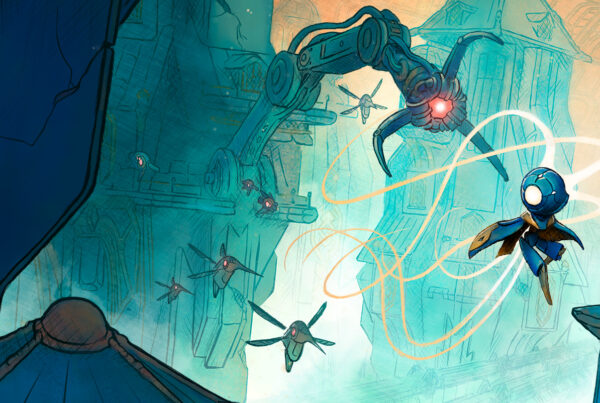
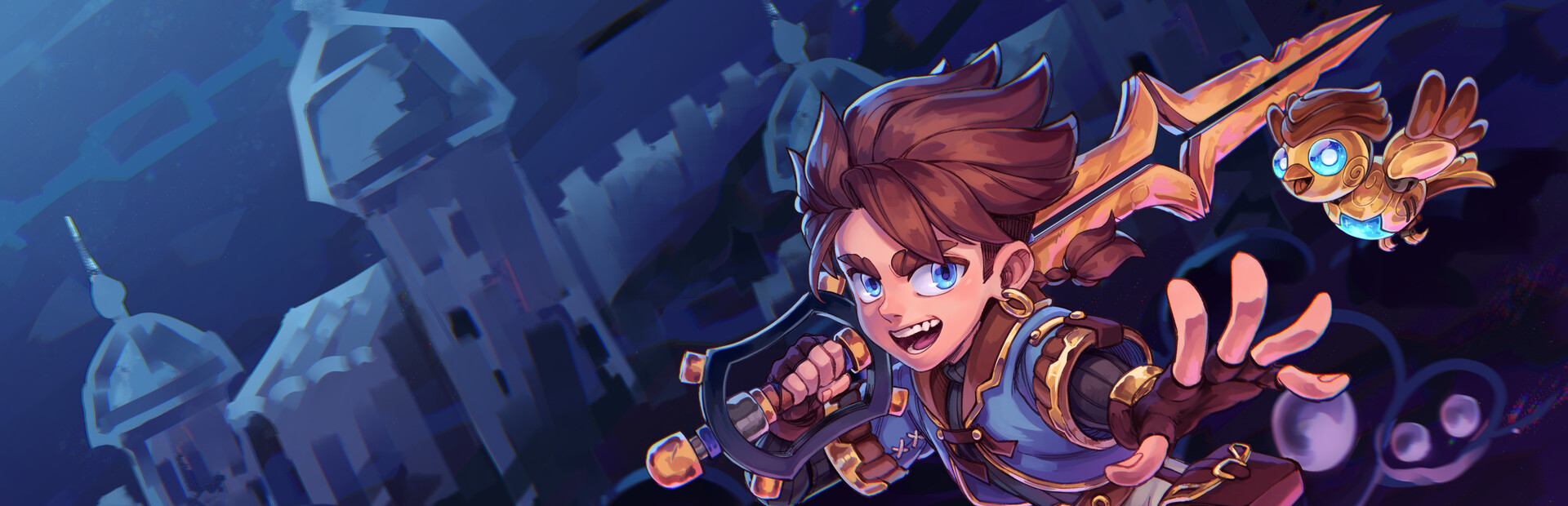
Let’s start with the premise, because everything looks really promising here. We have a world trapped in eternal night, a huge clock tower rising right in the middle of a town, and a pair of siblings who have to face something much bigger than an ordinary adventure. We play as Zirian, who sets out to rescue his sister trapped inside this “mutated” time tower, and along the way discovers that the entire land has been corrupted by the evil forces of certain masked figures. Cuckoo, a mechanical companion, joins us on our journey, while each new region is its own distinct land with its own color palette, themes and bizarre structures built around gears, pendulums and time crystals. It sounds like a solid mix of fairy tale, clockpunk and a story about dealing with loss – there are themes of grieving for a grandfather, loneliness, burying yourself in work and trying to fix the world instead of yourself (and even some memes!). The problem is that the further you get, the more the story fades into the background and aimless wandering takes its place.
Duskfade is a 3D platformer that really wants to be “open”, but ends up as a tangle of corridors, semi-open spaces and paths pretending to offer freedom. In theory, we have regions that can be explored in different orders, teleporters leading back to the town that serves as a hub, as well as a handful of side activities, secrets and collectibles scattered around the corners of the world. In practice, I spent most of my time wondering where the hell I was supposed to go. The game tries to help with special bells that supposedly point you in the right direction, but their logic is so unintuitive that sometimes they lead you to another empty corner instead of anything resembling a meaningful objective. With no map, readable compass or even a simple objective marker, after a few hours you start to lose your mind – I walk around, go in circles, hit dead ends every few minutes, and increasingly find myself dreaming of simply returning to the console menu and pressing that beautiful little “delete” button.
You really feel this in the first chapter, which revolves around following a giant chain wrapped around the main objective. At first, I thought: cool idea, a visual thread leading you toward the heart of the action, and since there are several of them, this is going to be great. After an hour, I had enough. You walk, walk and walk, sometimes you jump, sometimes you fight, but essentially you keep going in circles because every section looks more or less the same and the sense of progress is pretty much nonexistent. Once I realized that this kind of structure was going to keep coming back, I honestly started wondering whether I even wanted to see the campaign through to the end. Especially since the whole thing easily runs into the double digits, which, with this much emptiness packed into every section, is simply exhausting.
Mechanically, Duskfade is a mix of jumping, climbing, swinging on ropes and simply hacking away at enemies with a time sword. Zirian has the usual set of moves: a jump, double jump, dash and ledge grabbing, with more flashy tricks coming later, such as using a grapple and short “teleports” between points. The controls are fine – the character moves smoothly, the animations feel good, and getting onto platforms never becomes frustrating on a purely technical level. I also give the combat some credit for not being overly complicated – there’s a simple attack system, dodges, occasional use of time powers and several enemy types that at least try to vary the pace of encounters. The problem is that these mechanics exist somewhat in isolation. It’s rare to come across a section that combines movement, combat and puzzles in an interesting way. Instead, the game serves everything separately: a bit of platforming here, a few enemies in an arena there, and then a painfully basic “puzzle” involving a switch. There’s also a skill tree that lets you slightly boost your damage, mobility or stamina, but I never felt like it changed the overall experience. At some point, I simply stopped caring about what I was going to unlock next – the game gave me no reason to get excited about it.
The story is there, but I feel like it struggles to break through just how boring the game can get at times. The premise itself is actually pretty cool – we have a pair of siblings, a huge catastrophe tied to time, a town that’s losing its rhythm, and the mysterious Despair hanging over everything. It’s pretty obvious that someone wanted to say more here than just “go defeat evil and come home.” The problem is that the story is stretched way too thin. Cutscenes are few and far between, and for long stretches we simply walk around the world without much dialogue. Then, when something finally starts happening, we get a few minutes of cutscene before going right back to the same monotonous march. Because of that, even the more important events don’t have nearly as much impact as they should. On top of that, part of the story is told through notes and short entries that are easy to miss, especially when you’re already sick of checking every corner of the map for the umpteenth time.
Audiovisually, Duskfade looks pretty good, although I feel like the game doesn’t quite know how to make the most of it. The clockwork cities, stained-glass halls, lands suspended in the clouds and forests lit by the cold glow of time crystals can all look really impressive. The colors are strong, the lighting does its job, and the environments look especially good when the game pulls the camera back and gives you a wider view. I did have one specific problem, though – the colors. There are a lot of strange hues, strong combinations and sunsets here that can look really nice on their own, but on my new TV I simply couldn’t find settings that made everything look the way it was supposed to. I deliberately fired up games I know really well to check whether the problem was actually my new TV, which had only been two days old when I started playing. It wasn’t – everything looked normal in other games. Here, the image just looked… weird. Maybe the review build was missing some proper display settings, or perhaps the game simply didn’t play nicely with my TV, but there were several moments when I genuinely felt like I wasn’t seeing the game the way I was supposed to.
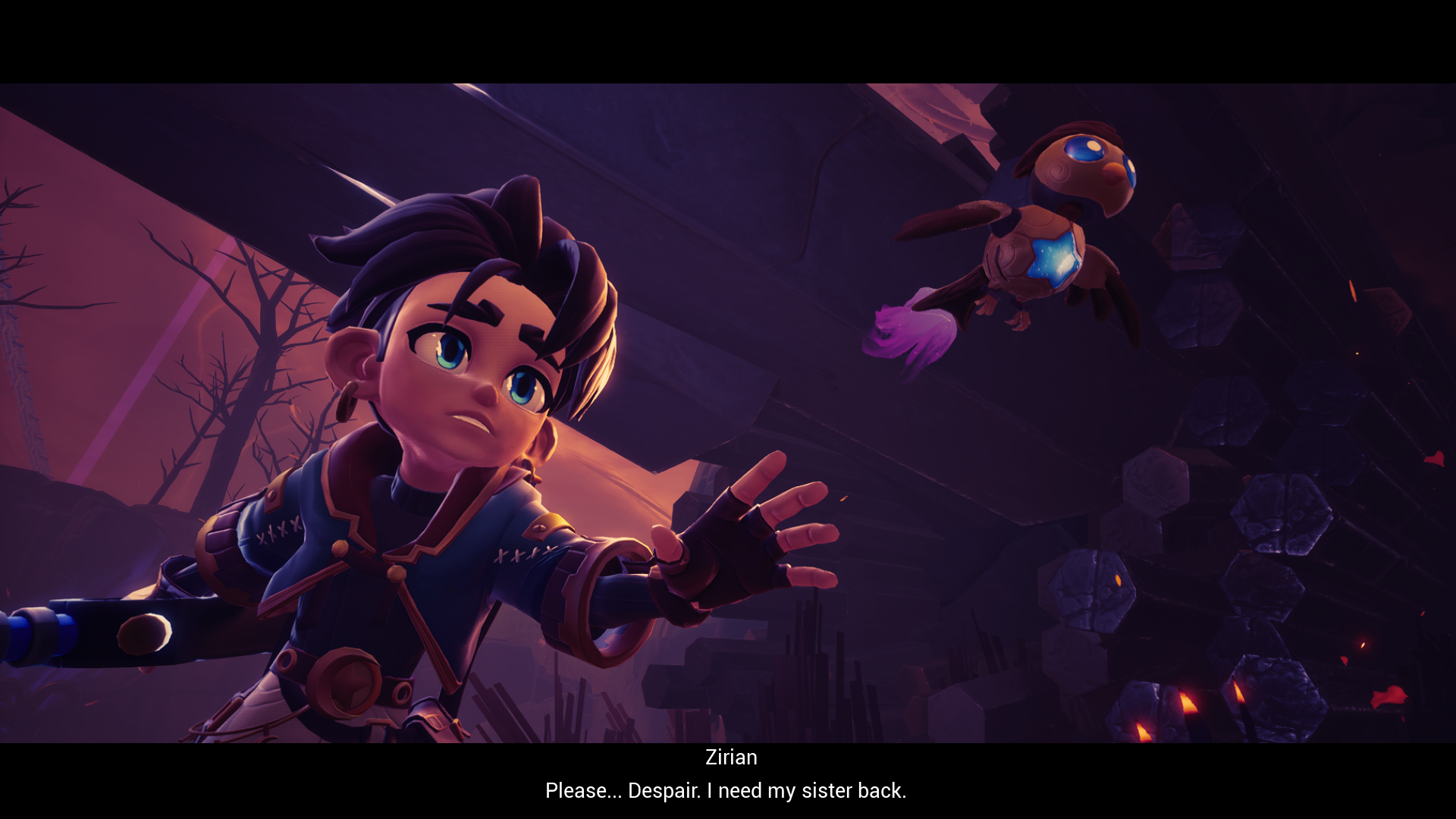
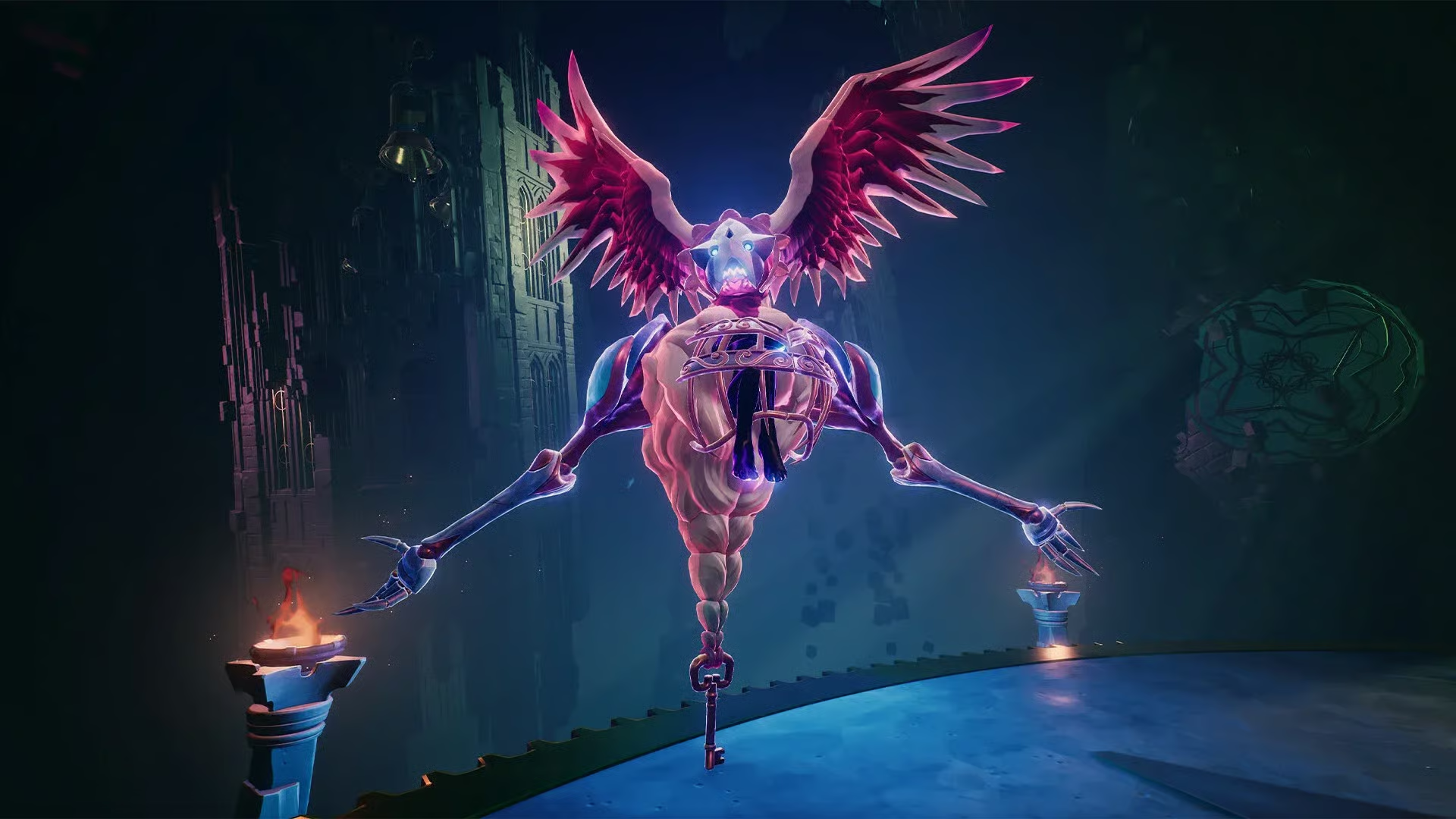
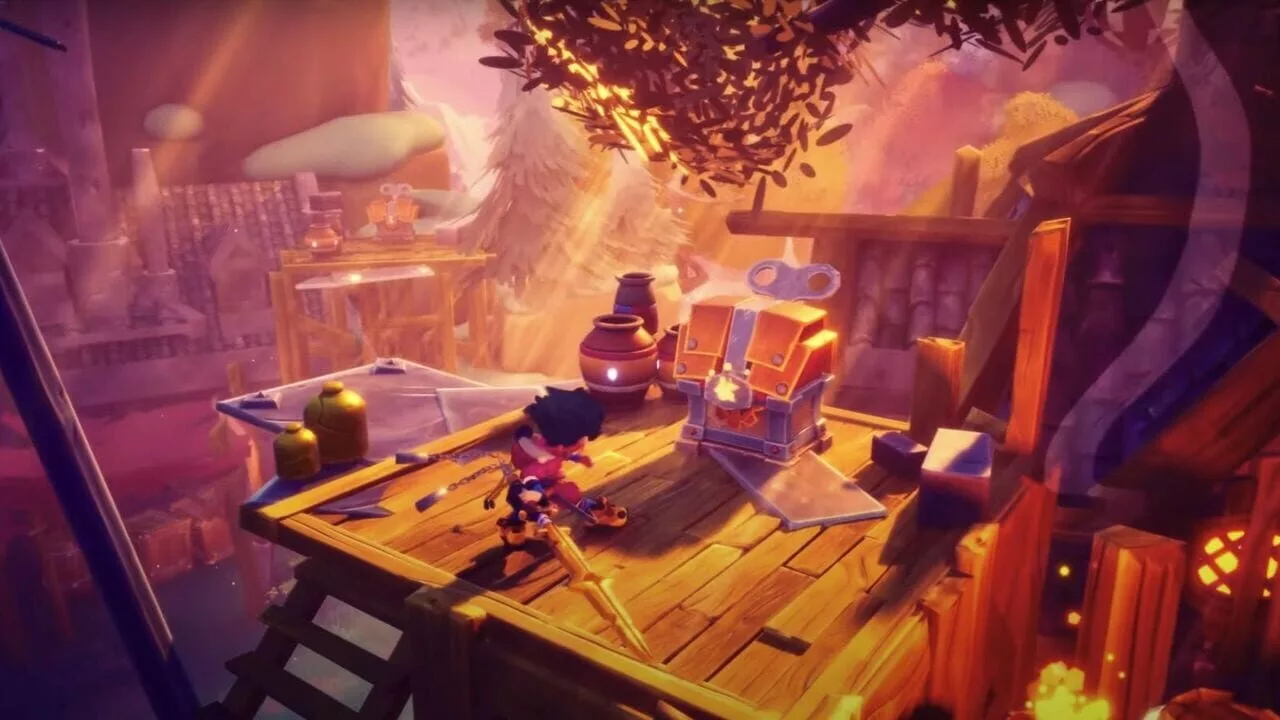 It’s a shame that there often isn’t much behind all that beauty. The enemies are just… there – neither particularly scary, creative nor memorable. The main characters have a likable design, but they’re not exactly characters I’ll remember for long. Technically, the PS5 version is fine – the game runs smoothly, I didn’t run into any major bugs (okay, there was a bit of falling through the ground), and loading times are reasonable. I also liked some of the particle effects. The music mostly serves as background – there are calm themes during exploration, softer moments in dramatic scenes and some fairly standard “action” stuff during the more intense sections. The sound effects do their job too, but I can’t exactly say I was humming any of these tunes after turning off the console.
The biggest problem with Duskfade, however, is that the game is simply empty. The world looks like a place where a grand adventure should be waiting for us, but in practice, we spend a lot of time walking through lands where very little happens – and hitting crates with a sword to see whether something falls out of them or not. There are few interesting interactions, rare surprises and repetitive ways of dealing with obstacles, which quickly start to wear me down. The side activities mostly boil down to collecting things and a handful of challenges that I’m more likely to tick off than actually enjoy doing. The first chapter dragged on so much that I genuinely felt like I was playing a badly stretched-out demo – something that should have lasted half an hour was stretched to an hour and padded out with a few enemies. And that’s only the beginning, because the campaign easily runs for more than ten hours, reaching thirteen without much trouble if you’re not rushing through it. At this pace and with this level of repetition, every extra hour works against the game.
Of course, Duskfade isn’t without its strengths. This world has potential, and the visual ideas are often really cool. The whole idea of breaking the shackles of time also opens up plenty of possibilities for interesting themes. There are moments when the platforming briefly steps up a level – obstacles are packed more tightly together, there’s a slightly more demanding sequence, and movement and abilities are put to good use. The mechanical companion gives the game a bit of character, and a few scenes involving Zirian’s sister genuinely manage to hit emotionally. It’s just a shame there aren’t more moments like these. Most of the time, I’m simply bored. Pretty views and occasional flashes of brilliance can’t hide the fact that the game has pacing problems and is really bad at respecting the player’s time.
So who is Duskfade actually for? I’d say people with a high tolerance for getting lost and repetition, who also enjoy the aesthetics of the first wave of 3D platformers. If you simply like wandering around different lands, looking at pretty scenery and don’t mind every other puzzle being another switch and platform, you might get more enjoyment out of this than I did. Kids will probably get bored here – the pace is too slow, there’s too little action, and the objectives are often too unclear for a family-friendly experience (and when they don’t need to talk, they suddenly talk way too much). If you’re looking for a polished, focused platformer with a strong narrative and distinctive mechanics, I’d approach Duskfade with caution. It’s not a disaster, but it’s definitely not in the same league as the presentation and premise would have you believe.
My final score is 5 out of 10. Duskfade feels like the first major game from a studio with plenty of heart and plenty of ideas, but one that is still learning how to properly turn those ideas into levels, pacing and a rewarding experience for the player. You can feel the inspirations, the ambition and the attempt to bring back a certain kind of adventure, but at the same time I kept feeling that the developers had forgotten what makes this genre so engaging at its best. Instead of a smooth journey, I got repetitive walks through empty lands, constantly losing my way and tasks stretched out far longer than they needed to be. My personal score says it all: this is a very average platformer that you can finish, but it’s hard to love.
In the end, I can only say that after these few hours, I’m not angry – just disappointed. I was hoping for a fun, varied adventure in a world of clocks and nighttime lands, but what I got was a journey that tries to feel like a grand epic adventure while being surprisingly empty underneath. If the developers ever return to this idea, I hope they remember next time that pretty scenery isn’t enough – the most important clock in a platformer is the one ticking inside the player’s head.
Thanks to Fireshine Games for providing the review code.