
September is shaping up to be a rather unusual month, but also something of a treat for film and television fans. One adaptation of The Doll will arrive in cinemas, while another will premiere on Netflix as a six-episode series. What is particularly interesting is that these will not be two identical productions. Both versions take noticeably different approaches to the source material and to telling the same story.
I had the opportunity to watch Netflix’s The Doll ahead of its premiere. I had been looking forward to it for quite some time, so I would like to thank Netflix for giving me early access to all six episodes.
First and foremost, there is one very important thing that needs to be said. Netflix’s The Doll tells the story we know from Bolesław Prus’ classic novel, but it is not a faithful, scene-by-scene adaptation. In several places, the plot clearly diverges from the original book. Some events have been changed, others are resolved in an entirely different way, while elsewhere the creators have shifted the focus between particular storylines and characters.
And I want to make this clear right from the start – for me, this is absolutely not a criticism. Quite the opposite.
Netflix’s The Doll is not, however, a simple attempt to modernize a classic. And I would not describe it that way, because that is absolutely not what the creators are trying to do. They do not force contemporary issues into the 19th century or attempt to turn The Doll into something it was never meant to be.
It is, rather, a reinterpretation.
The story has been reworked in a way that preserves the spirit of the original while also making sure that viewers genuinely want to follow these characters over the course of six episodes. And in my opinion, that is exactly what the series achieves.
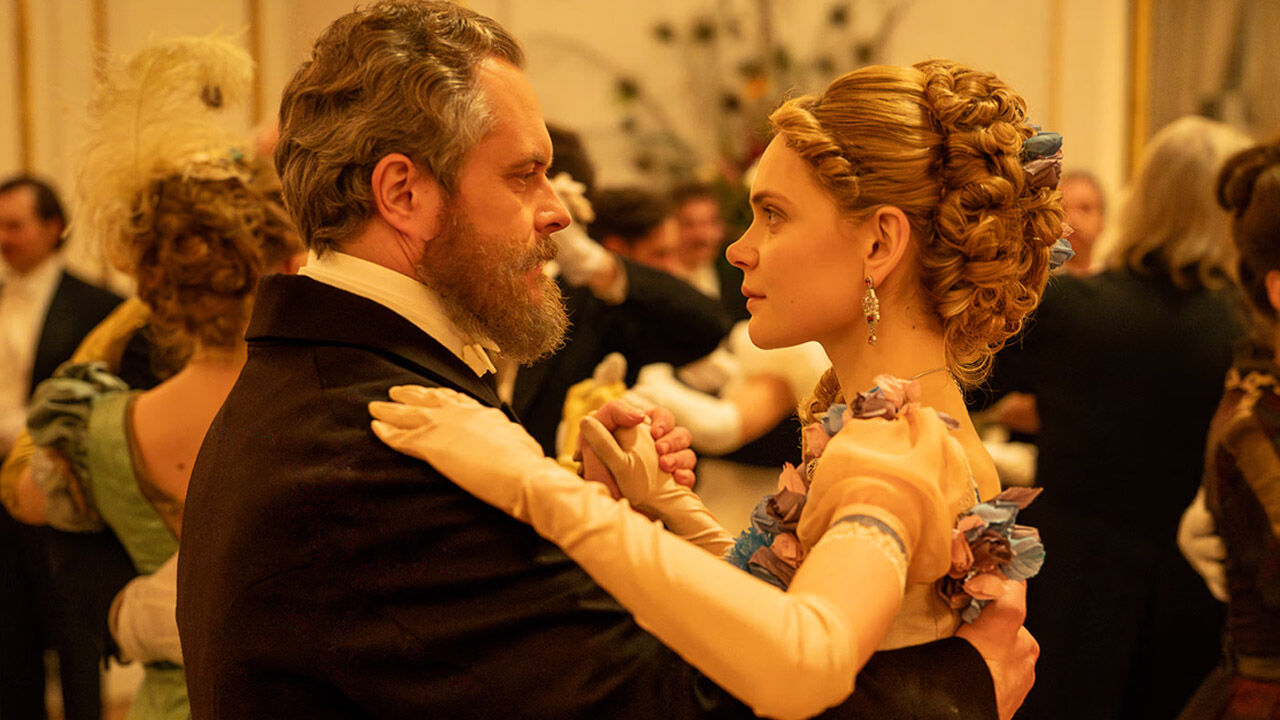
The leading roles are played by Tomasz Schuchardt as Stanisław Wokulski and Sandra Drzymalska as Izabela Łęcka. The cast also includes Dariusz Chojnacki as Ignacy Rzecki, alongside Jacek Braciak, Magdalena Cielecka, Mateusz Król, Małgorzata Hajewska-Krzysztofik, Piotr Pacek, and Piotr Adamczyk.
And I have to admit that the casting works really well.
Tomasz Schuchardt as Wokulski is highly convincing. He has the right amount of roughness, a distinctive physical presence, and, most importantly, he feels completely at home in the role. His Wokulski is simply a character you can believe in. I genuinely struggle to point to anything about his performance that feels out of place.
Sandra Drzymalska as Izabela Łęcka is equally well cast. Throughout most of the series, she has this distinctive – and, dare I say, almost permanent – resting bitch face that fits the character perfectly. I know that may not be the most sophisticated description, but honestly, I cannot think of a better one.
Simply looking at her Izabela Łęcka, you immediately understand exactly who this character is.
The supporting cast performs just as well. Piotr Adamczyk as Krzeszowski is believable and fits naturally into the world of the story. Jacek Braciak as Tomasz Łęcki, Magdalena Cielecka as Kazimiera Wąsowska, and Dariusz Chojnacki as Ignacy Rzecki are also strong in their respective roles. It is genuinely difficult to point to anyone who clearly stands out in a negative way.
And this brings me to one very specific observation – it genuinely feels like they wanted to be there. I do not know whether it comes from the costumes, the opportunity to appear in an adaptation of one of Poland’s most important novels, or perhaps simply the atmosphere on set. Watching The Doll, however, I had the impression that the actors genuinely enjoy inhabiting this world. You can see the commitment. It never feels as though they are simply treating the series as another job to get through. Instead, they seem genuinely comfortable in their roles and in the world the production creates around them.
Lately, while watching some productions, I have increasingly found myself with the impression that certain actors simply perform their scenes, deliver their lines, and wait for the shooting day to end. I did not get that feeling here. Almost every actor brings something to their character, and as a result, the entire story feels considerably more believable.
When it comes to the plot itself, it has been reworked in a genuinely thoughtful way. Most of the familiar characters and storylines are still here, although some situations have been changed or resolved differently. And once again – in my opinion, none of this comes at the expense of the source material. I therefore have no real problem with the fact that certain things differ from the book, especially since it is difficult to point to any major writing flaws, pointless decisions, or moments where the creators clearly seem unsure of what they are doing. What is more, while watching the series, I repeatedly had the impression that every change had been made as part of a clear idea for this particular version of the story. If someone told me that this was exactly what the original The Doll looked like, that Prus had written the novel precisely this way and that I was watching a nearly word-for-word adaptation, I would probably love the book even more.
Because this version of the story simply works. I never had the feeling that changes were introduced merely for the sake of changing something. Nor does it feel like an attempt to forcibly „fix” a classic. The creators simply chose their own path, and the result is a story that works extremely well in a television format. And that is probably this production’s greatest strength for me.
Of course, one can debate whether specific changes to the novel were necessary. I am sure there will be people who simply do not like this approach, particularly when it comes to The Doll, a novel that generations of Poles know from school and have their own expectations about. However, not once while watching the series did I feel that anyone was trying to destroy the source material. Quite the opposite. I had the impression that the creators understand exactly what The Doll is about, understand its characters and its most important themes, and then attempt to tell this story in their own way. And they do so very effectively.
When it comes to the technical side of the production, I have to say one thing – we finally have dialogue that is simply easy to hear and understand. Perhaps that should not be anything special, but after several recent Polish productions, I have genuinely started to appreciate it. I did not have to turn the volume up to the maximum just to understand what the characters were saying. It may sound obvious, but it is still important. Everything here has been recorded very well. The dialogue is clear, the sound causes no problems, and at no point did I feel like I had to fight with my television settings. The music also does its job well. At the right moments, it creates a specific mood – sometimes more romantic, sometimes heavier, and in certain scenes even slightly unsettling. Most importantly, however, it never tries to dominate the series. It does not push itself into the foreground when it is not needed, but effectively builds the atmosphere where it should and complements what we see on screen.
The sets and costumes also work very well. In fact, when it comes to the latter, I would say they are more than just good. They are simply beautiful. The costumes are exceptionally well chosen, varied, and genuinely eye-catching. Sometimes colourful and striking, at other times much more traditional, but almost always perfectly suited to both the individual characters and the world of the story. If you enjoy historical costumes, you will definitely have plenty to look at here. The production as a whole looks genuinely impressive and, once again, it is difficult for me to find anything particularly serious to criticize. The production design does its part as well. We get the key locations, beautiful interiors, elegant residences, and gardens. The world of The Doll looks believable and appropriately elegant, making it easy to feel immersed in the atmosphere of the story.
I do, however, have one small observation.
Of course, I know where The Doll takes place. Warsaw is one of the most important settings in the story, and I never expected the creators to show us every corner of the city. Still, as someone who knows Warsaw well, I occasionally felt that there could have been a little more of the city itself. The most important locations are certainly there. We see Rzecki’s shop, elegant residences, beautiful gardens, and distinctive spaces that help recreate the atmosphere of 19th-century Warsaw. So, generally speaking, it works well. But at times, I simply felt that there was not quite enough Warsaw. I would have liked to see more of a city that plays such an important role in this story. This is not a problem that negatively affects the overall experience of watching the series. It is more of a personal observation and perhaps the result of knowing Warsaw well enough to simply want to see more of it in the production. Because what we do get looks great. And, having watched the entire series, I found it genuinely difficult to identify elements in Netflix’s The Doll that could clearly be described as major shortcomings. Almost.
And unfortunately, this is where we get to the one element that really bothered me. Because as much as I enjoyed The Doll, and as comfortable as I am saying that it is one of the better period dramas I have watched in recent years, the production does have one noticeable technical weakness. The visual effects. And unfortunately, in several moments, they are genuinely poor.
The biggest problems involve fire and explosions, but some digitally altered or expanded locations also fail to convince. In these moments, the computer-generated elements become far too obvious. Sometimes they simply look bad. In a few scenes, the effects look downright embarrassing.
And that is a shame, because modern films and television series use visual effects far more often than we probably realize. Good CGI is usually invisible – it blends naturally into the image, and we simply do not pay attention to it. Here, however, the digital work becomes too obvious in several scenes. Fire, explosions, and some digitally expanded environments are particularly problematic. And these are the moments when The Doll noticeably stumbles.
I do not know whether the issue was budget, time, or simply a lack of refinement in these particular scenes. What I do know is that it could have been done better. And unfortunately, it does stand out. This is especially noticeable because The Doll is a Netflix production intended for an international audience. The story itself is very good, the actors are excellent, the costumes are beautiful, and the production design is largely impressive. That makes it all the more disappointing that the visual effects stand out so clearly from the rest of the production in several scenes.
I also have to admit that, at certain moments, The Doll reminded me a little too much of Bridgerton. I am obviously not talking about copying its plot or characters. It is more about the overall aesthetic, the way relationships are presented, the visual appeal of the costumes, and occasionally the general character of the production. At times, I had the impression that the creators were trying a little too hard to turn The Doll into a contemporary period spectacle.
Then again, perhaps that is partly why the series is so enjoyable to watch. I never felt as though I was watching a Polish version of Bridgerton, though. This is still The Doll – simply a version of the story that has clearly been designed with a contemporary audience in mind.
There is one more thing that surprised me from time to time. I am not entirely convinced that some of the profanity is really necessary. Of course, people swore in the 19th century as well, and I am not going to pretend that everyone spoke in perfect, literary language back then. This is more about my own impression while watching the series. In certain scenes, I felt that some of the language did not quite fit the overall tone of the production – the social conventions we see, the way the characters behave, and the atmosphere of the world itself.
The same applies to several sex scenes. There is absolutely nothing inherently wrong with them. People have always had sex, and there is no reason to pretend that such things did not exist in the 19th century. Most of these scenes also make sense within the story and the relationships between the characters. At times, however, I felt that they clashed slightly with the rest of the series – with its symbolism, social conventions, and the atmosphere the creators establish elsewhere. This is not a major criticism, though. It is simply something that occasionally surprised me and, at times, felt somewhat unnecessary. Ultimately, I see it as part of the creators’ vision.
Netflix’s The Doll, at least in my opinion, works very well as a modern reinterpretation of this story. But it is a modernization that never goes too far. Most importantly, it still remains firmly rooted in its own era. The creators do not try to turn it into a contemporary series that merely happens to feature 19th-century costumes. The atmosphere, historical setting, and most important elements of the story have been preserved, while still allowing room for certain changes.
And that is precisely why the differences from the novel did not bother me while watching. Even when I noticed that the creators had chosen a different path from Prus, I still felt that I was watching a coherent and carefully constructed story. And that is what matters most to me.
Is Netflix’s The Doll worth watching? In my opinion, definitely. I think it is a very good series. As an adaptation, it may naturally be more open to debate, primarily because it is not a faithful recreation of the novel. And I certainly would not recommend preparing for your final exams solely by watching these six episodes.
But as a television series? Genuinely excellent. I watched The Doll with great interest, and I would have no problem watching it again. The story drew me in, the cast was convincing, the costumes and production design made a huge impression, and the way this classic novel was reworked worked very well for me in the vast majority of cases.
Of course, it is not a perfect production. The visual effects can be genuinely painful to watch at times and clearly fall below the standard set by the rest of the series. Occasionally, the show reminded me a little too much of Bridgerton, and some scenes or creative decisions are certainly open to debate. Even so, I am not afraid to say that this is one of the better period dramas of its kind that I have seen in recent years.
I do not yet know how the upcoming theatrical version of The Doll will compare. Its premiere is still ahead of me, but you will of course also be able to read my review of it on my blog. And I will not hide the fact that comparisons with Netflix’s version will probably be impossible to avoid.
For now, though, we have this version of The Doll. And I genuinely think you should watch it. Not as a substitute for studying the novel, but simply for yourselves? Definitely.
This is a genuinely solid television series and a pretty good The Doll.