
From the very first trailer, Deer & Boy looked like the kind of game made specifically for me. A dark, intimate platformer that tells its story without words, choosing emotion over flashy combat—those are exactly the kinds of experiences I enjoy the most. Naturally, I went into it with high expectations. Unfortunately, the more time I spent with the Nintendo Switch 2 version, the more I found myself fighting technical issues instead of soaking in the atmosphere. And that’s a real shame, because beneath all those problems lies a genuinely good game.
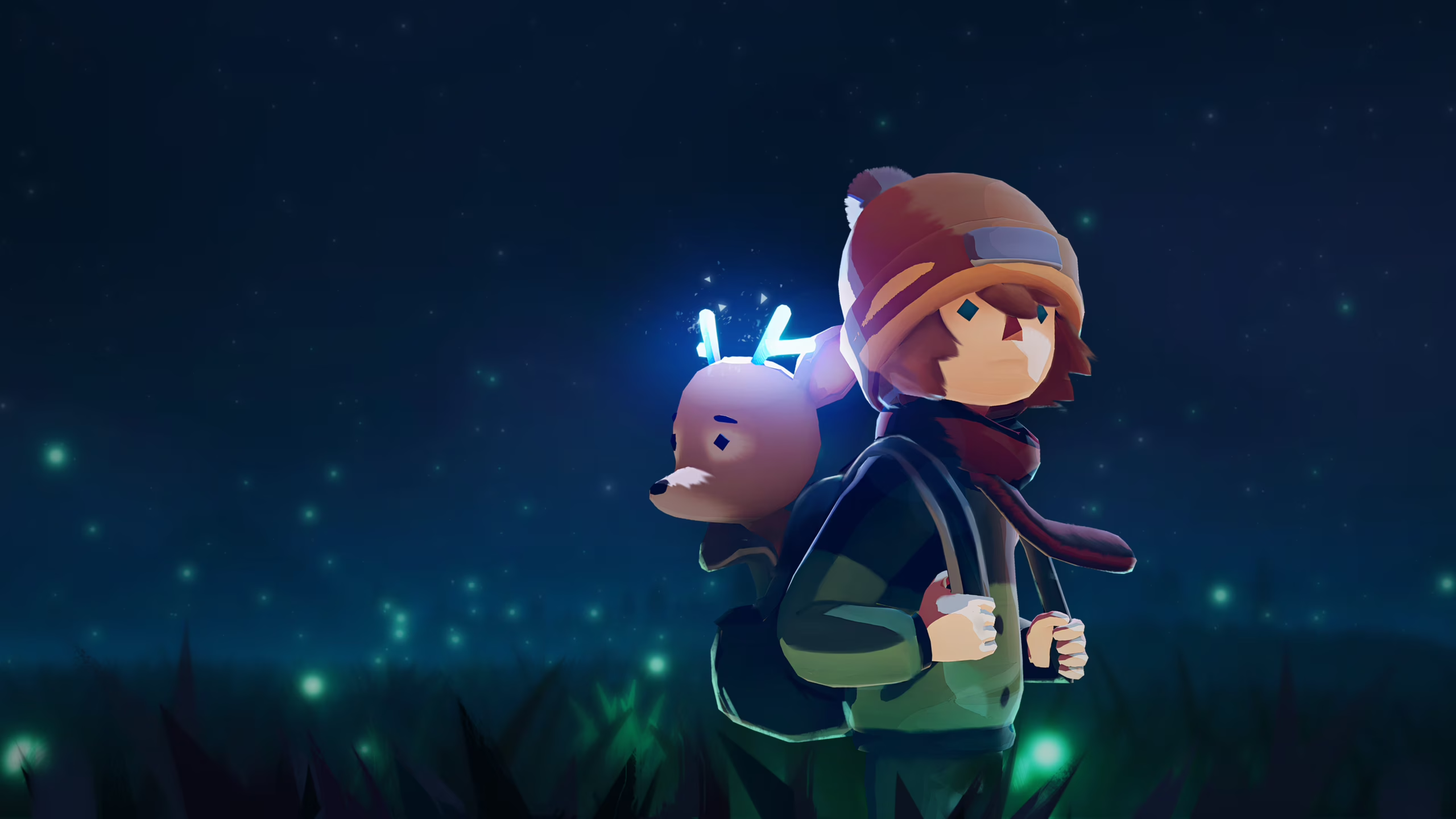
The story follows a young boy who runs away from home and, during his journey, encounters an injured fawn. Their growing bond quickly becomes the emotional core of the entire experience. There are no spoken lines or lengthy cutscenes here. Instead, the developers rely on visual storytelling, music, and subtle character animations to convey the narrative. It works remarkably well from the very beginning, and it didn’t take long before I found myself genuinely rooting for both of them.
What impressed me the most was the game’s atmosphere. Rain-soaked streets, deserted locations, police officers searching for the boy, and construction workers you instinctively avoid all create a constant sense of danger. It genuinely feels like you’re experiencing the world through the eyes of a child who has run away from home and is desperately trying to survive in a world that suddenly feels much bigger—and much more threatening—than ever before.
The story itself is where Deer & Boy starts to lose some of its momentum. It begins as a grounded, believable, and emotionally engaging tale, but as it progresses, supernatural elements gradually take center stage. In my opinion, they end up weakening the narrative rather than enriching it. Instead of focusing on the bond between the boy and the fawn and the very human emotions at its core, the story drifts into symbolism, metaphors, and a mysterious purple force that never really clicked with me. I couldn’t shake the feeling that the developers overcomplicated a story that was far more powerful when it kept things simple.
From a gameplay perspective, Deer & Boy doesn’t reinvent the genre, but it’s consistently enjoyable to play. You’ll jump, climb, push crates and logs, solve straightforward environmental puzzles, and work together with your little companion. One mechanic I particularly liked was carrying the fawn in your backpack and placing it in specific locations to solve puzzles. It’s a simple idea, but it’s satisfying to use and does a great job of strengthening the bond between the two characters.
Not everything works equally well, though. Chase sequences often rely on trial-and-error rather than skill, making them more frustrating than exciting. Some puzzles also suffer from poor visual readability. There were several moments where I got stuck—not because the puzzle itself was difficult, but because I simply couldn’t spot an interactive object hidden somewhere in the shadows. Sometimes I couldn’t find the solution because, quite frankly, I could barely see anything at all.
The biggest issue with this version—I’m not judging the other platforms, although I have my suspicions—is undoubtedly its technical performance. I played the game on Nintendo Switch 2, and frequent frame rate drops were impossible to ignore, especially whenever the game performed an autosave. There were noticeable stutters, flickering textures, and moments where the visuals simply fell apart. In handheld mode, I could forgive some of those shortcomings, but once I connected the console to my TV, every technical flaw became far more obvious. Blurry textures, heavy aliasing, and shimmering shadows constantly pulled me out of the experience, despite atmosphere being one of the game’s greatest strengths.
I also spent most of my time playing with the Switch 2’s new performance boost mode enabled—the feature designed to mimic docked performance while playing handheld. It already struggled in that mode, so out of curiosity I turned it off to see how the game performed without it. Honestly, I don’t think I’ve seen image flickering and frame drops this severe in almost a decade. What makes it even more disappointing is that the Switch 2 is clearly capable of running far more demanding games. Seeing it struggle with what’s essentially „a boy running to the right through dark environments” feels difficult to justify.
Thankfully, the audio is one area where Deer & Boy truly shines. The soundtrack is subtle and never tries to steal the spotlight, yet it perfectly complements the game’s melancholic tone. During quieter moments, you’re accompanied by soft melodies, the sound of falling rain, and the footsteps of the protagonists, all of which make the world feel even more immersive. As the story becomes more emotional or the pace picks up, the music naturally grows in intensity without ever losing its understated charm. This is definitely one of those games that’s best experienced with headphones, as the sound design is just as important to the storytelling as the visuals.
Deer & Boy is a game with a lot of heart. What stayed with me the most was the relationship between the boy and the fawn, the beautifully crafted atmosphere, and the confidence to tell its story without relying on dialogue. Those elements kept me invested from beginning to end, despite the fairly simple gameplay. It’s just unfortunate that the narrative gradually moves away from its grounded, emotional premise in favor of symbolism and supernatural themes that never feel quite as effective. Even more disappointing, however, is the technical state of the Nintendo Switch 2 version. Performance issues, visual glitches, and inconsistent image quality constantly pull you out of an experience that should have been defined by its atmosphere.
On a personal note, Deer & Boy is exactly the kind of game I usually fall in love with. I have a real soft spot for dark, intimate platformers that tell emotional stories through atmosphere rather than dialogue, so I genuinely wanted this one to become something special. Unfortunately, the Nintendo Switch 2 version makes that surprisingly difficult. Performance hiccups, visual issues, and a few questionable narrative choices repeatedly pulled me out of the experience just when I was becoming fully immersed.
That said, I don’t think Deer & Boy is a bad game—not even close. In fact, I think there’s a genuinely touching and worthwhile adventure hidden beneath its flaws. I simply believe it deserved a more polished release, because in better technical condition I’d have no hesitation recommending it to fans of atmospheric cinematic platformers.
I chose the Nintendo Switch 2 version mainly because it was the cheapest option, so in a way I knowingly accepted a compromise. Even so, I think it’s fair to expect a game like this to run far better. I’m not asking for revolutionary gameplay or cutting-edge technology—I simply expect a cinematic platformer released in 2026 to deliver a smooth, polished experience instead of constantly breaking immersion with technical shortcomings.
Final Score: 6/10
I still think Deer & Boy is worth checking out, especially if you’re a fan of melancholic, narrative-driven platformers. However, if you have the option, I’d seriously consider playing it on a different platform. And if you’re looking for a game with a similar atmosphere, I’d recommend Planet of Lana—and especially its sequel, Planet of Lana II: Children of the Leaf. In my opinion, they simply execute the formula much better in almost every aspect.